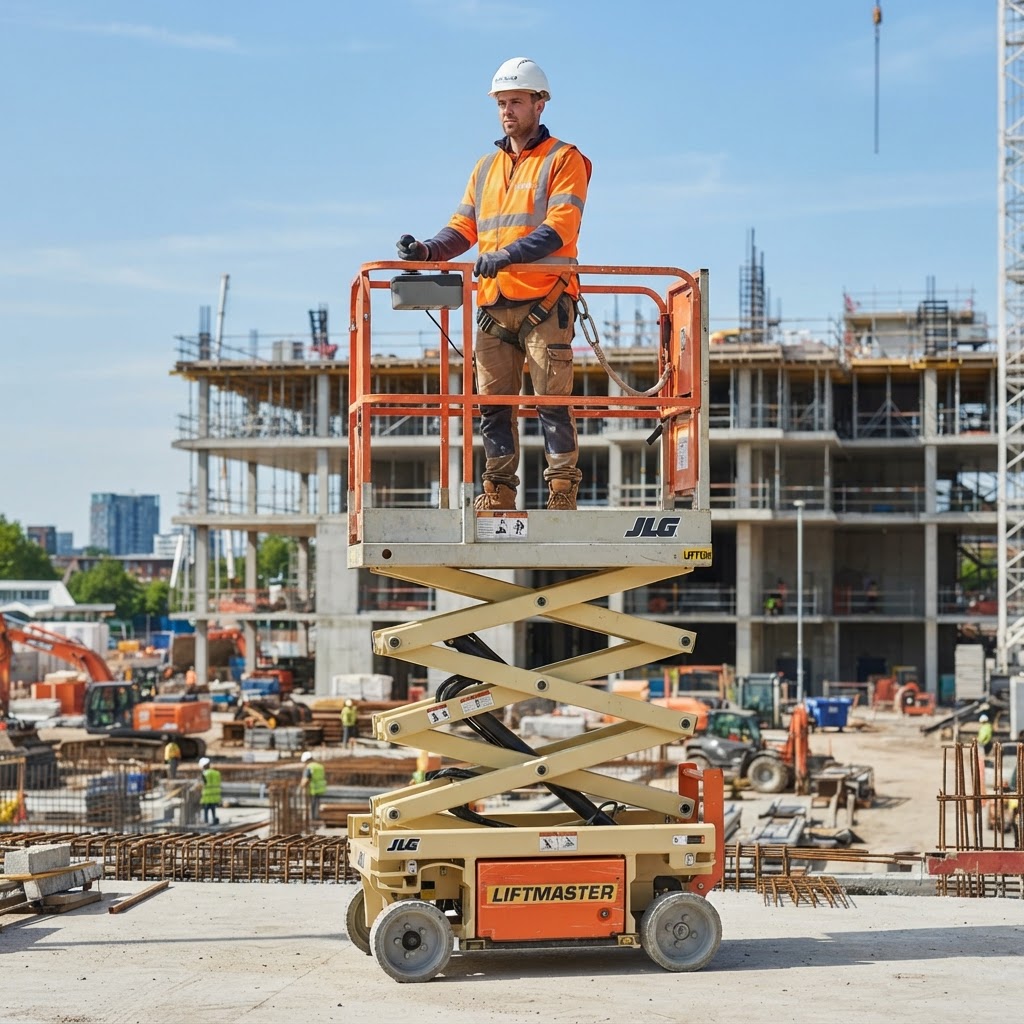
Key Takeaways
Operating a boom lift or scissor lift on a jobsite requires OSHA-aligned safety certification. This guide walks through who needs it, what the training covers, how long certification lasts, and how to earn your certificate online in about 1.5 hours.
How to Get Your Boom Lift & Scissor Lift Operator Certificate
Aerial lifts — boom lifts and scissor lifts — are everywhere on a modern jobsite. They get you up high fast, but they also come with real hazards: tip-overs, falls, electrocution, and collisions. That is why OSHA-aligned operator safety training is not optional. It is the baseline for anyone stepping onto a lift platform.
If you are about to operate one of these machines, here is exactly what you need to know about getting certified.
What is aerial lift operator safety training?
Aerial lift operator safety training is a structured course that covers the hazards of operating boom lifts and scissor lifts and the procedures you must follow to use them safely. A good course walks you through what to do before you turn the machine on, how to inspect it, what load-capacity limits mean, and how to follow OSHA's classroom training requirements.
The training is designed around the real-world situations that cause injuries on jobsites: falls, objects dropping from the platform, tip-overs, ejections, structural collapses, electric shock, and contact with ceilings or overhead objects.
Who needs to be certified?
More people than you might think. This training is not just for full-time lift operators. It applies to:
- Crane and lift operators who run the equipment daily
- Mechanics who maintain or move lifts
- Project managers and site supervisors who need to understand what their crews are doing
- Tree trimmers who use aerial lifts to reach branches
- Warehouse workers who use scissor lifts for high shelving
- Sign installers, HVAC techs, and electricians who work at height
If your job puts you on or around an aerial lift, you should have this certification on file.
What the training covers
A comprehensive aerial lift safety course will walk you through:
- Types of aerial and scissor lifts — what makes each one different and when to use which
- Pre-shift and post-shift inspections — what to check before you trust the machine with your weight
- Safety procedures before, during, and after use — the full operating cycle
- Accident and hazard types — so you can recognize danger before it happens
- Electrocution and contact injuries — how to work safely near power lines and structures
- Manufacturer guidelines — why the manual matters and how to read it
- Fall protection and PPE — harnesses, hard hats, and anchor points
- Securing components and equipment access — keeping the platform and ground safe
OSHA requirements: what you are actually meeting
A legitimate course aligns with OSHA's safety training standards. The relevant standards include:
- OSH Act of 1970 (general duty clause)
- 1910 Subpart F — Powered Platforms, Manlifts, and Vehicle-Mounted Work Platforms
- 1910.29 — Manually Propelled Mobile Ladder Stands and Scaffolds
- 1910.67 — Vehicle-Mounted Elevating and Rotating Work Platforms
- 1910.333 — Selection and Use of Work Practices
- 1926.21 — Safety Training and Education
- 1926.451–1926.454 — Scaffolding general requirements, specific types, scissor lifts, and training requirements
- 1926.501–1926.502 — Duty to Have Fall Protection
- 1926.556 — Aerial Lifts
When you complete an OSHA-aligned course, you satisfy the classroom portion of the requirement. Note: most employers also require a hands-on evaluation on the specific equipment you will operate before you are considered fully certified for their jobsite.
Fall protection on a scissor lift — what OSHA actually says
This is one of the most misunderstood parts of lift safety. Scissor lifts require guardrails — that is the primary fall protection system. The guardrail must be inspected as part of your daily check.
A personal fall arrest system (PFAS) is only required on a scissor lift if:
- The manufacturer specifies it (rare)
- The guardrail system is inadequate
- The worker must leave the work platform, at which point the scaffolding standard applies
In most cases, you cannot attach a PFAS to a guardrail — OSHA prohibits it, and most manufacturers do not provide another anchor point. Knowing this distinction is part of being a certified operator.
How long does certification last?
Aerial lift certification is valid for three years, though some employers require more frequent refreshers. You may also need to re-train if:
- You start operating a different type of lift than you were originally trained on
- Your employer observes unsafe behavior that suggests your initial training was inadequate
- You are involved in an accident or near-miss
Keep your certificate on file and know your expiration date — it is your proof of compliance.
How to become a certified operator — step by step
1. Choose an OSHA-aligned online course. Look for a course that explicitly references the OSHA standards above. A typical aerial lift safety course takes about 1.5 hours to complete and is 100% online, so you can train anywhere.
2. Complete the coursework. You will work through modules on lift types, inspections, hazard prevention, fall protection, and safe operating procedures. Take the material seriously — this is the knowledge that keeps you alive at height.
3. Pass the exam. Most courses include a test at the end. You need to pass it to receive your certificate.
4. Print your certificate of completion. Once you pass, you can print your certificate immediately. Keep a digital and physical copy.
5. Complete a hands-on evaluation with your employer. The online course satisfies the classroom requirement. Your employer is responsible for evaluating you on the actual equipment you will operate — this is the practical component OSHA expects.
6. Keep your certification current. Renew every three years (or sooner if your employer requires it), and re-train any time you switch to a new type of lift.
How long does the online course take?
The classroom portion typically takes around 1.5 hours. Because it is online and self-paced, you can complete it in a single sitting or break it up. Just note that most courses expire 60 days after purchase — so do not let it sit unfinished.
What if I lose my certificate?
If you lose your certificate of completion, contact your training provider's support team. Reputable providers can re-issue your certificate so you always have proof of training on file.
Why this matters for your jobsite
Every year, workers are injured or killed operating aerial lifts — from falls, tip-overs, electrocutions, and contact with overhead objects. Certification is not red tape. It is the baseline knowledge that prevents those incidents.
If you are renting a boom lift, scissor lift, or boom truck through RentMall, make sure every operator on your crew has current certification before the equipment arrives. It protects your people, your project timeline, and your compliance record.
Need a boom lift or scissor lift for your next job?
RentMall connects you with local vendors who have the right equipment — at prices that compete for your business. Tell us what you need and we will handle the rest.